



Hiiii, welcome to the new-look Friday Freelance Tips!
If you’re reading this, you’ve made the jump over to Substack with me, and I’m SO glad you’re here.
A quick heads up: this is the first edition on the new platform, so there might be a few teething issues along the way. If you see a wonky link or a formatting gremlin, no you didn’t 👀 Please bear with me while I get everything settled in. I promise I’ll be tidying things up as I go.
The intro to this newsletter is CHUNKY, so bear with! Appreciate you 🫶
Why I moved to Substack
I’ve been sending this newsletter for almost five years(!) now, and it’s always been one of my favourite parts of the week. But I’ve had a growing feeling that I wanted it to be more than an email that lands in your inbox and gets read (or, let’s be honest, sometimes skimmed) before being archived.
So here’s why I made the move:
I want to build more of a community around it. A lot of you reply to these emails, and those conversations are the best bit. I’d love to give that a proper home, rather than it all living in individual inboxes (but you’re also still v welcome to email me!).
I want one place for everything. Substack means I can share resources, playbooks, and guides alongside the newsletter, all in one spot, rather than scattering them across different tools and links.
I want to be able to go deeper. The weekly email is great for quick, useful tips, but there’s so much more I want to share that doesn’t fit into a five-minute read.
What’s changing (and what isn’t)
The important bit is you’ll still get the newsletter every week, for free, as a subscriber. Nothing about that is changing and it won’t ever change.
What’s new is that there’s now also a paid tier, for anyone who wants to go a bit deeper into building and growing a freelance business they love. Over the coming weeks and months, that’ll include:
My weekly stats in a lot more detailr. What I’ve been working on, how much I’ve earned, the lot. I’ll be moving these across in the next couple of weeks
Detailed, practical playbooks you can implement each month, like the one I’m about to tell you about
Challenges to help you build and grow your business, with a bit of accountability built in
A WhatsApp community so you can chat with me and other freelancers
Free tools and other bits and pieces to make freelance life a little easier
The point of all of it is the same as it’s always been: helping you build a freelance business you actually enjoy running.
The format of the Friday newsletter is staying very similar. Every Friday, you’ll get:
A little opening spiel from me, usually an observation or something going on in my freelance world or the freelance world in general
A link to my latest Instagram post
A useful tip you can implement straight away
The October playbook is live
Speaking of playbooks, the first one is ready to go! The October Freelance Playbook is a play-by-play guide to what you should be doing in your business this month, based on the time of year, so nothing sneaks up on you before the holidays.
👉 Read the October playbook here
Here’s what’s inside:
The exact scripts to chase overdue invoices before the hols
The exact scripts to pitch existing clients on locking in work for next year
The exact wording for giving clients a heads-up before you put your rates up in January
A referral-ask template for the most wonderful time of the year
The gut-check for deciding which clients don’t make it into next year
A script for communicating your holiday availability
A testimonial-request script for projects that just wrapped
A list of scaled-down seasonal service ideas, if you want to run a Black Friday-style offer
Ready-to-swipe content ideas and post templates for social media
The full plug-and-play October checklist
Pick a few things off the list each week through October, and you’ll head into the end of the year feeling a LOT calmer than if you leave it all until December.
Here’s what I’ve been up to this week work-wise:
👉 I refreshed 2 pieces for Shopify
👉 I wrote 2 pieces for clients (Modash and Spoke)
👉 I worked on some social content for a client
👉 I created a new LinkedIn hub for a new client
👉 I guested on a podcast
👉 I had a call with a client I’m starting with in Nov
⏱ Approx hours spent on client work this week: ~24
⏱ Approx hours spent on non-client work: ~2
💰 Total revenue from client work this week: £3,970
P.S. This week on Instagram, I shared a bit about how I turned my skills and passions into well-paying freelance services. A juicy carousel for ya! Check it out here.
A word from this week’s sponsor…
It can be really hard to find professional development that is affordable and relevant for freelancers.
Many Hats exists to fill that gap. Online, accessible, affordable workshops for freelancers that focus on skills development, led my experts in their field. From making Tax Digital to branding and marketing yourself, from building a pipeline to identifying transferable skills, check out many-hats.org/events to book your tickets.
Check out my practical resources that have helped 500+ people get more clients, earn more money, and create better content.
This week’s tip: how I structure my freelance proposals so clients (usually) say yes
Last week, I shared the three-tier pricing strategy I use to take the fear out of sharing my rates. That’s one big piece of my proposals, but it’s faaaaar from the only one. So this week, I wanted to walk you through what my proposals look like.
Here’s the structure I follow every time.
1. I keep it short at two pages max
Nobody wants to scroll through pages and pages of text to work out what they’re being offered. I only include the key information, and nothing else. A short, easy-to-scan proposal is far more likely to get read properly, and far more likely to get a yes.
2. I restate what we talked about.
Right at the top, I remind the client what we spoke about, what the project is for, who’s involved, and what the goal is. It’s a simple thing, but it shows them I’ve listened and I understand the project, before I even get to what I’m going to do about it.
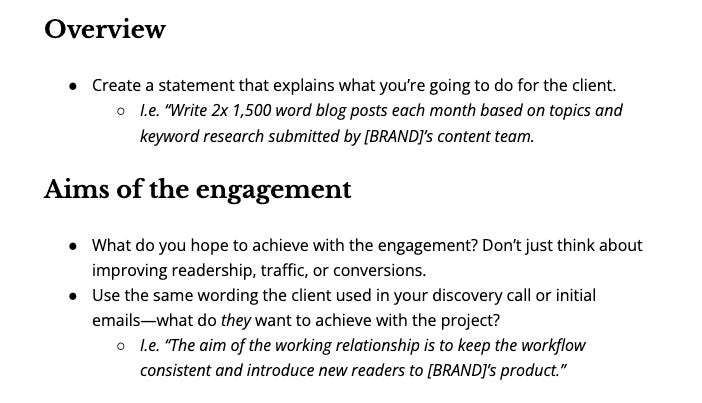
3. I state their goal in their own words.
I take the goal almost word for word from their initial email or our discovery call. Seeing their own words reflected back makes it instantly clear that I get what they’re trying to achieve.
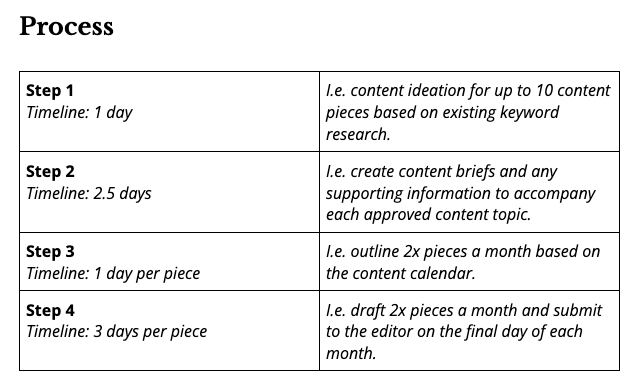
4. I lay out the scope, with a timeline.
Next comes what’s involved: the work, the timeline, and what’s needed from me and from them at each stage. This means they know what’s required of them at each stage and how much input they might need - handy, if they were planning to be more hands-off, for example. They can then query that and we can back-and-forth (we all love a bit of back-and-forth, eh?!).
5. I offer three packages at different price points.
This is where the three-tier pricing comes in. Each package covers the scope at a different level, so the client can compare what they get at each price, choose the option that suits them, and feel in control of the decision rather than being handed a single take-it-or-leave-it number.
6. I link to similar work and relevant testimonials.
Rather than just telling a client I can do the job, I show them. I link to similar projects I’ve done in the past, plus any testimonials that are relevant to the type of work they’re asking about.
When you bring it all together, you have a proposal that’s short, clear, and (most importantly!) built around the client’s own goals, with a bit of proof and a bit of choice thrown in for good measure.
It takes the pressure off them to work out whether I’m the right person, and takes the pressure off me to find one perfect price.
A quick note if you’re just starting out: you don’t need a fancy design or a slick template to make this work. Get the structure right first (their goal, your scope, a few options, some proof) and you can polish the look of it later.
That’s it for this week! If you try out the proposal structure, or dive into the October playbook, I’d love to hear how you get on.
Thanks for coming along for the ride while I get set up on Substack.
Have a brilliant weekend,
Lizzie ✨
Interested in sponsoring Friday Freelance Tips? Get your brand, product, or service in front of 8,000+ freelancers, entrepreneurs, and founders. See sponsorship options here.
Follow me on Instagram and on Linkedin, where you can see the behind-the-scenes of my business.
Great to have you here Liz
This is SO helpful!!